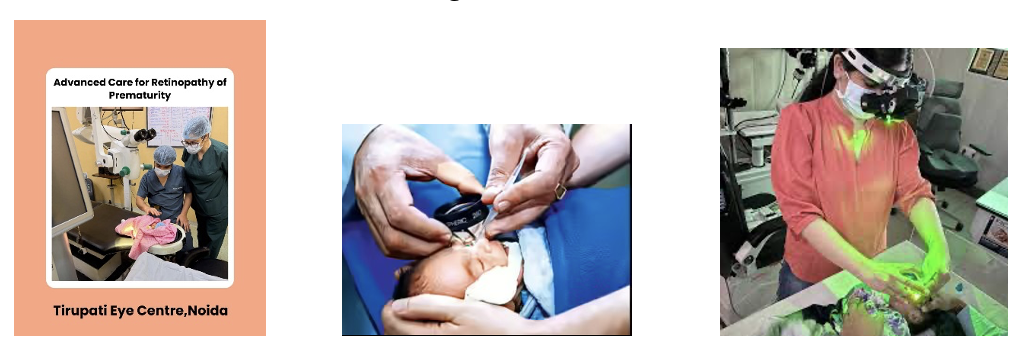
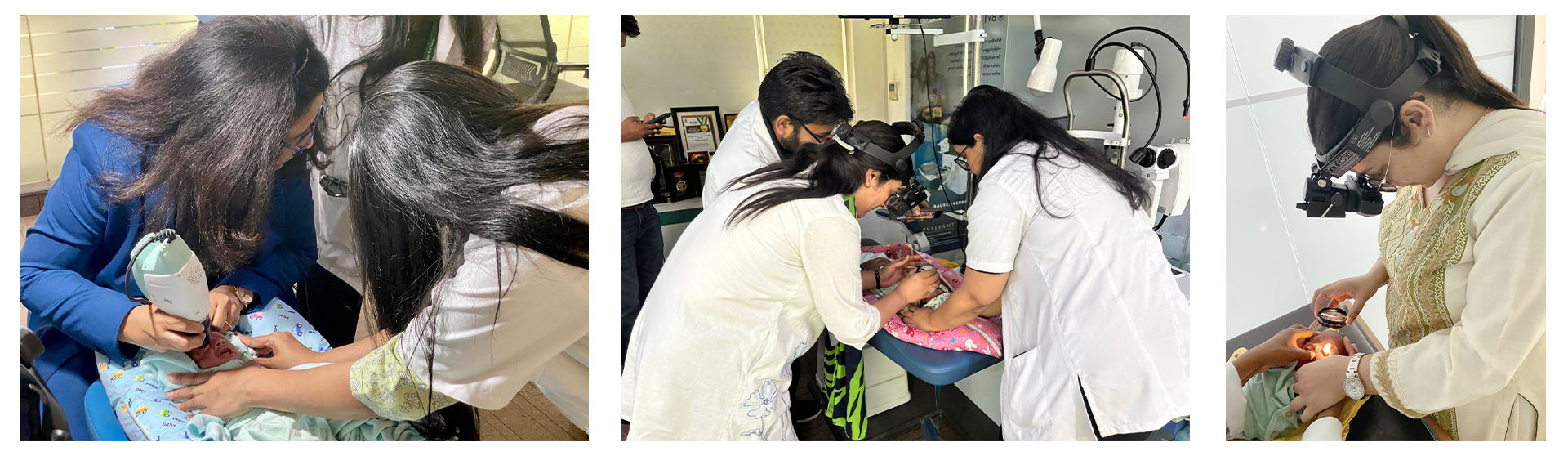
At Tirupati Eye centre, we believe that every child’s eye is important and we want to build a world without childhood blindness. For this we have a very well-designed ROP screening and treatment program with trained ophthalmologists and advanced equipment to diagnose and treat ROP. We do now want even a single child in India to become blind.
What is ROP?
Retinopathy of prematurity (ROP) is an eye disease in some premature babies born before 31 weeks. (A full-term pregnancy is about 38 to 42 weeks). It is a problem that affects the tissue at the back portion of the eye called the retina. The retina is the most important part of the eye and it senses light and sends signals to the brain so that you can see. With ROP, unwanted blood vessels grow on the premature baby’s retina. These blood vessels can cause serious eye and vision problems later.
ROP may go away on its own as an infant grows. But as the infant grows, they should be seen by an ophthalmologist regularly. Sometimes urgent treatment is needed to prevent blindness. If not treated in time, the child can have severe permanent vision loss or even go blind.
What Causes Retinopathy of Prematurity?
Blood vessels in the eyes normally finish developing a few weeks before birth. An infant who is born early is exposed to many different things, especially oxygen in the NICU (neonatal intensive care unit). Medicines, oxygen, bright lights, or temperature changes might affect how an eye’s blood vessels develop, and can result in abnormal blood vessels to develop.
Here are some of the things doctors think might contribute to ROP:
Premature infants are more likely to get ROP if they have other health problems. These problems include anaemia (low levels of iron in the blood), not enough vitamin E, infections or breathing problems
Diagnosis
Shortly after birth, all premature babies should be checked for retinopathy of prematurity (ROP), ideally within 4 weeks or at 31 weeks, whichever is later. An ophthalmologist can examine the infant’s eyes while they are in the hospital. However, ROP might not be visible until several weeks after birth. So, premature babies at risk for ROP are usually checked by an ophthalmologist at 4 weeks after birth and again thereafter at 1-2 weeks intervals, as advised by the ophthalmologist (eye doctor).
It is important to take your baby to all follow-up appointments with your ophthalmologist. Timely detection and treatment can help prevent permanent vision loss.
How is ROP Treated?
At first, an ophthalmologist may monitor ROP to see if it goes away on its own. If abnormal blood vessels continue to grow, the infant’s eyes must be treated.
The ophthalmologist may treat ROP in one or more of the following ways, depending on the stage of ROP:
With the specialized laser treatment, the ophthalmologist uses a laser to burn away the edge of the retina, all around the eye. This treatment target very specific parts of the retina to try to stop abnormal blood vessel growth.
Also, anti-VEGF medications are now used to treat ROP. These drugs are injected (given as shots) into the eye to stop unwanted blood vessel growth.
Research is also underway on newer anti VEGF medications for ROP. These drugs are injected (given as shots) into the eye to stop unwanted blood vessel growth.
As babies with ROP grow, they need to be checked regularly by an ophthalmologist for vision problems. Having ROP can lead to being nearsighted, or having a detached retina, lazy eye or misaligned eyes in long run. It also increases the risk of having glaucoma. These problems may be treated by:
Timely screening for ROP in premature infants can prevent blindness
Team trained for ROP: Dr Mohita Sharma, Dr Sabreena Hasan, Dr Abhinav Kacholia, Dr Sneha Dixit, Dr Tanya Yadav, Dr Jyotsna, Dr Mayank Tyagi
1. Dry eye clinic started in 2024, featuring diagnostic IDRA and therapeutic Pulse therapy treatment launched in 2024.
2. Binocular vision and Orthoptics Clinic launched in January 2025, with the aim of providing orthoptics related treatment.
3. The Rotary Salasar Noida Eye Bank & Research Institute was inaugurated at Tirupati Eye Centre in June 2025 in association with the Rotary Club of Noida to provide eye banking facilities in Noida to fight corneal blindness.
4. Project Drishti was launched in September 2025 by Rotary Club of Noida in association with Tirupati Charitable Trust with the aim of conducting 200 free cataract surgeries in 2025-2026 for thos e who cannot afford treatment.
5. Maitreyi Pushpa Charity Wing launched in 2025 with the aim of performing 2,000 free cataract surgeries in a year. The wing was inaugurated by Chief guest and renowned writer Maitreyi Pushpa. Guests of honour were Ex BJP spokesperson Ms Nupur Sharma and ACP Swantantra Singh.
6. Dr R C Sharma Research Wing launched in 2025 with the aim of conducting research to find new treatment modalities by participating in global trials.
7. Dr Mohita Sharma, the founder and Chairperson elected as Joint Secretary of the All India Ophthalmological Society, the world's largest society of ophthalmologists in March 2026
.
8.Dr Mohita Sharma, Founder & Chairperson, was appointed as District Interact Chair of Rotary District 3012 for 2026-2027.
9.Tirupati Eye Centre & Dr Mohita Sharma received a felicitation for their work in healthcare from the Honorable MLA of Gautam Budh Nagar Shree Pankaj Singh, during the "Swarnim Noida" function celebrating 50 years of Noida, organized by the Dainik Jagran newspaper in April 2026.
10. 4,000 cases of advanced surface ablation (bladeless, flapless and touchless LASIK laser) were completed to achieve spectacle independence in April 2026.